
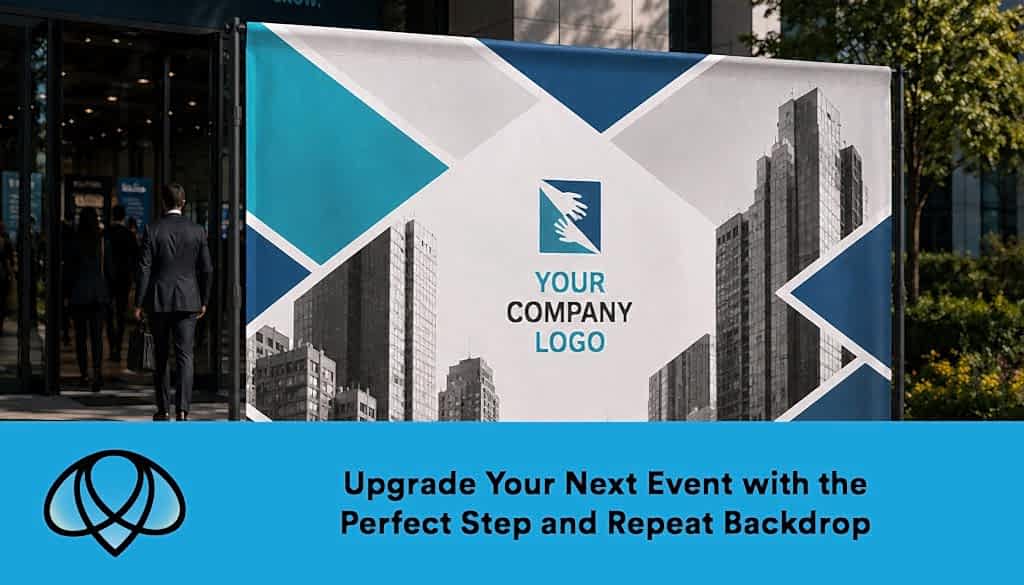
A step and repeat backdrop is a large printed panel featuring a logo, or a small set of sponsor logos, arranged in a repeating pattern so that at least one logo is visible no matter how a photo is cropped. It gets its name from the way guests “step” up for a photo, then move down the line to repeat the process for the next group. These backdrops are a staple at press conferences, red carpet premieres, corporate galas, and charity fundraisers because they turn every event photo into a piece of branded media. The two most common sizes are 8 feet by 8 feet, which comfortably fits two to four people, and 8 feet by 10 feet, which accommodates larger groups of four to six. Materials typically fall into two categories: matte vinyl, which is more budget-friendly and holds up well outdoors, and fabric, which offers a softer, non-reflective finish that’s especially well suited to flash photography. Choosing between them, along with the right size and layout, depends mostly on the venue, the expected group sizes, and how the backdrop will be photographed. The sections below walk through each of those decisions in detail.
Why a Custom Step and Repeat Backdrop Is Essential for Professional Events
A step and repeat backdrop does something no other piece of event signage can: it becomes part of every photo taken in front of it. Guests, press, and influencers naturally gravitate toward a well-designed backdrop for photo opportunities, which means the branding on it ends up circulating across social media, press coverage, and personal photo albums long after the event ends. This makes it one of the most cost-effective forms of extended brand exposure available to event planners.
Beyond the marketing value, a professional backdrop also elevates the perceived quality of an event. A blank wall or a generic pop-up banner reads as an afterthought, while a custom-printed backdrop signals that the event was planned with care — which matters just as much for a corporate product launch as it does for a red carpet premiere.
How to Choose the Best Step and Repeat Backdrop Size for Your Venue
Sizing a step and repeat backdrop comes down to two questions: how many people will typically stand in front of it at once, and how tall is the ceiling or space where it will hang? An 8-foot by 8-foot backdrop is the most popular standard size and comfortably fits two to four people. An 8-foot by 10-foot backdrop is a common upgrade for larger groups of four to six, and extension kits are available on many stands to expand a backdrop up to 16 feet wide for larger step-and-repeat walls.
As a general planning rule, budget roughly two feet of width per person you expect to photograph together, and keep the minimum height around 8 feet so that logos remain visible even behind taller standing guests.
Design Tips That Make Your Logo Stand Out in Every Event Photo
The repeating pattern is the defining feature of a step and repeat design, and getting the spacing right matters more than most people expect. Step and repeat design guides recommend a staggered logo pattern rather than a strict grid, which prevents an awkward crop where a logo gets cut in half directly behind someone’s head. High-resolution vector artwork is essential, since the design will be enlarged significantly and any pixelation becomes obvious in professional photography.
Color and contrast matter as well — a logo in a color close to the background tone can wash out under camera flash, so it’s worth testing high-contrast combinations before finalizing the design. Keep the layout relatively simple: one primary logo repeated cleanly reads far better in photos than a cluttered mix of multiple sponsor logos competing for space.
Best Uses for Step and Repeat Backdrops at Corporate, Charity, and Red Carpet Events
Corporate events use step and repeat backdrops for product launches, press days, and company milestones, where consistent branding in every photo reinforces the company’s presence across media coverage. Charity events and galas use them at check-in areas and photo stations, giving donors a polished photo opportunity while reinforcing sponsor recognition throughout the evening.
Red carpet events remain the most iconic use case, where a backdrop lines the entrance or photo area so that every press photo and influencer post carries the event’s branding. Trade shows also use step and repeat backdrops at booths and demo stations as a compact way to reinforce a brand without the footprint of a full display wall.
Fabric vs. Vinyl Step and Repeat Backdrops: Which Is Right for Your Event?
| Material | Best For | Key Tradeoff |
| Matte Vinyl | Outdoor events, frequent reuse, budget-conscious bookings | More affordable, but can show wrinkles from rolled storage |
| Fabric (Polyester/Canvas) | Indoor press events, red carpets, flash photography | Non-reflective and glare-free, but not recommended outdoors in wet weather |
Vinyl is the more economical and durable option for frequent use, especially outdoors, since it’s water-resistant and holds its shape well over repeated setups. Fabric offers a softer, completely matte finish that eliminates camera flash glare, which is why many press and red carpet events lean toward fabric even at a slightly higher cost. Material comparison research notes that fabric backdrops are also machine washable and tend to last longer with proper care, which extends their value for organizations reusing the same backdrop across multiple events. Fabric also folds more compactly for storage and travel, while vinyl typically ships and stores rolled in a tube.
Common Mistakes to Avoid When Ordering a Custom Event Backdrop
The most frequent mistake is choosing glossy vinyl instead of matte — a glossy finish reflects camera flash directly back into the lens, which can wash out or completely ruin event photos. Undersizing the backdrop for the expected group size is another common issue, leaving guests standing outside the printed area in photos. Skipping a design proof before printing is also risky, since a spacing error in a repeating logo pattern is far more noticeable once printed at full size than it appears on screen.
Ordering too close to the event date without accounting for production and shipping time can also create unnecessary stress. Building in a buffer of at least a week or two before the event date gives room for a design revision if something doesn’t look right on the first proof.
How Professional Step and Repeat Backdrops Boost Brand Visibility and Social Media Exposure
Every photo taken in front of a step and repeat backdrop is, in effect, a piece of branded content that the event didn’t have to create or distribute itself — attendees do that automatically when they share their photos. This is especially valuable at events with press coverage or influencer attendance, where a single well-branded photo can reach an audience far larger than the event itself.
Because the branding repeats across the entire backdrop, it also stays visible in wide shots and video coverage, not just close-up photos, extending its value well beyond individual snapshots taken directly in front of it.
What to Know Before Ordering a Step and Repeat Backdrop in Los Angeles
Before placing an order, confirm the venue’s ceiling height and available floor space, since these directly affect which size and stand configuration will work. Decide early whether the backdrop needs to be reused across multiple events, since that will influence whether fabric’s durability and easier storage are worth the added cost over vinyl.
Printing Fly produces custom step and repeat backdrops, event backdrops, and red carpet backdrops for events across Los Angeles, in both fabric and vinyl, with logo layout and spacing handled as part of the design process. Whether you’re planning a red carpet premiere or a corporate press day, our team can help you choose the right size, material, and finish for the event. Contact Us: 310-287-9982.